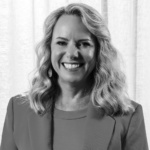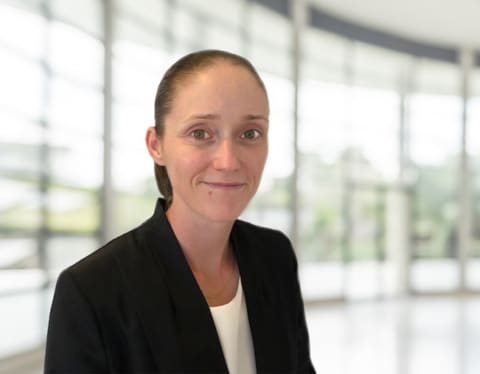

We sat down with Sarah to discuss her new role and vision for Systematiq
What motivated you to pursue the General Manager role, and how has your journey within Systematiq prepared you for this position?
Sarah Norton: “I was motivated by the chance to guide Systematiq’s next phase of growth and build on our achievements. My varied experience across delivery, operations, and pre-contracts has given me a clear understanding of what it takes to deliver for our clients. Working with a dedicated team has shaped my approach and prepared me to focus on performance, accountability, and sustainable growth in this role.”
Given the journey you’ve been on and where Systematiq has come from, what is your vision for the business going forward?
Sarah Norton: “My vision is to establish Systematiq’s position in the industry as a trusted capability partner that helps our clients introduce and deliver capability with confidence,” Sarah explains. “We will continue to build on our strong foundations in the ADF land domain while expanding our capability in adjacent sectors. Our focus will be continuing to deliver value to clients, developing our people, and growing the business in a deliberate and sustainable way.”
What are your immediate priorities as you step into this new role, and how do you plan to approach them?
Sarah Norton: “My immediate priorities are strengthening delivery consistency, clarifying roles and accountabilities, and ensuring our systems and processes support scale,” she notes. “I will focus on building strong leadership alignment, improving visibility across projects, and maintaining close engagement with clients to ensure we continue to deliver with confidence and predictability.
At the same time, I want our industries to see Systematiq as a dependable capability partner that can integrate quickly, provide skilled capacity, and support our clients and partners to achieve delivery outcomes with certainty.”
How do you see the defence and rail industry evolving over the next few years, and what opportunities or challenges do you anticipate?
Sarah Norton: “The defence industry is shifting toward faster delivery cycles, with a growing focus on speed to capability and the adoption of minimum viable capability approaches to get essential capability into service sooner and evolve it over time,” she observes. “Rather than waiting for fully mature solutions, programmes are increasingly prioritising operational readiness and iterative delivery, supported by closer collaboration between government, primes, and industry.”
She continues: “Similarly, the rail industry is seeing increased investment and a push for more efficient, integrated delivery, particularly as large-scale infrastructure programmes accelerate. There is a growing emphasis on coordination across stakeholders, maintaining delivery momentum, and ensuring projects transition smoothly from design through to operations.”
“This creates significant opportunity for organisations that understand these domains, can mobilise quickly, integrate into complex programmes, and deliver reliably under compressed timelines. At the same time, it raises expectations around workforce capability, programme discipline, and systems maturity.
The key challenge across both sectors will be balancing speed with assurance—ensuring capability is delivered quickly while maintaining safety, quality, and long-term sustainment outcomes. For organisations that invest in delivery readiness, scalable processes, and deep domain expertise, demand will continue to grow as both defence and rail sectors accelerate delivery.”
What strategies will you implement to foster a positive team culture and support professional development within the organisation?
Sarah Norton: “Our focus is on building a culture where people work well together, understand their role, and take pride in contributing to shared outcomes. Strong teamwork, clear expectations, and supportive leadership are critical to delivering successfully, especially on complex projects,” she says.
“We also want to make sure our people have access to great opportunities, working on interesting, challenging programmes that help them build experience and grow their careers over time. When people feel supported, trusted, and part of a team that delivers meaningful outcomes, that’s when culture and performance really come together.”